

How Often Should Children Practice Abacus at Home?
Learning to use an abacus is not only about understanding how the beads move. Children also need regular opportunities to practise what they learn, become comfortable with number patterns and gradually improve their calculation accuracy.
For most children, short and consistent practice sessions are more practical than an occasional long session. The right schedule, however, depends on the child’s age, experience, current learning level and ability to stay focused.
Parents supporting their child’s abacus training at home do not need to turn every practice session into another formal lesson. A simple routine that reinforces what the child has already learned can often be more useful.
So, how often should children practice, how long should each session last, and what should they actually do during that time? This guide explains.
Why Regular Abacus Practice Matters
Children usually learn abacus skills progressively. They may start by understanding the beads and number positions before moving towards addition, subtraction, faster calculations and eventually mental visualisation.
Regular home practice helps reinforce those steps.
A consistent routine can give children more opportunities to:
- Become familiar with bead positions
- Understand place value
- Review techniques introduced during classes
- Improve calculation accuracy
- Develop smoother bead movement
- Build confidence when solving number problems
- Practise independently
- Prepare for more advanced exercises
The goal should not be to make a child complete as many calculations as possible. Home practice should reinforce correct technique while helping the learner become comfortable with what they are studying.
How Often Should Children Practice Abacus?
There is no single schedule that suits every child.
A young beginner may only need a few short sessions each week, while a child who has been learning for longer may be comfortable practising more frequently.
A practical starting point can look like this:
| Learning Stage | Suggested Frequency | Example Session Length |
| Young beginners | 3–4 days per week | 10–15 minutes |
| Early learners | 4–5 days per week | 15–20 minutes |
| Intermediate learners | Around 5 days per week | 20–30 minutes |
| More experienced learners | 5–6 days per week | 20–30+ minutes |
These timings are general examples rather than fixed requirements. Parents should consider the exercises assigned by the child’s instructor and adjust the routine according to the child’s concentration, school workload and progress.
Is Daily Abacus Practice Necessary?
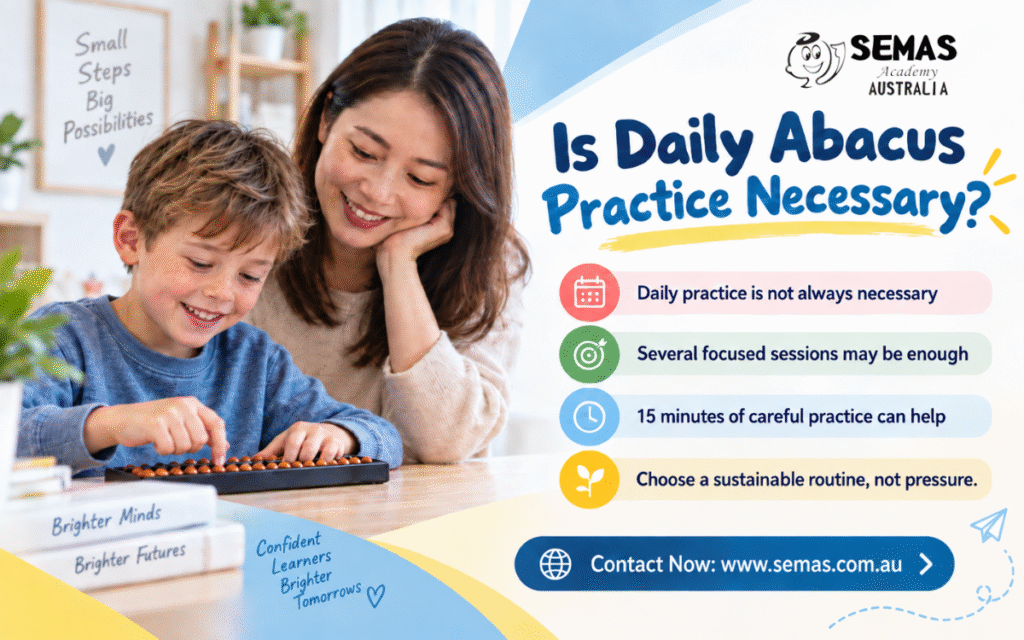
Not necessarily.
Practising every day can work well for some children, but daily sessions should not become a source of pressure. For younger learners in particular, several focused sessions across the week may be easier to maintain.
The quality of the practice also matters.
Fifteen minutes spent carefully completing exercises can be more useful than a much longer session where the child becomes distracted, frustrated or starts rushing through calculations.
Parents should look for a sustainable routine rather than assuming that more practice automatically produces better results.
How Long Should an Abacus Practice Session Be?
Age and learning stage should help determine session length.
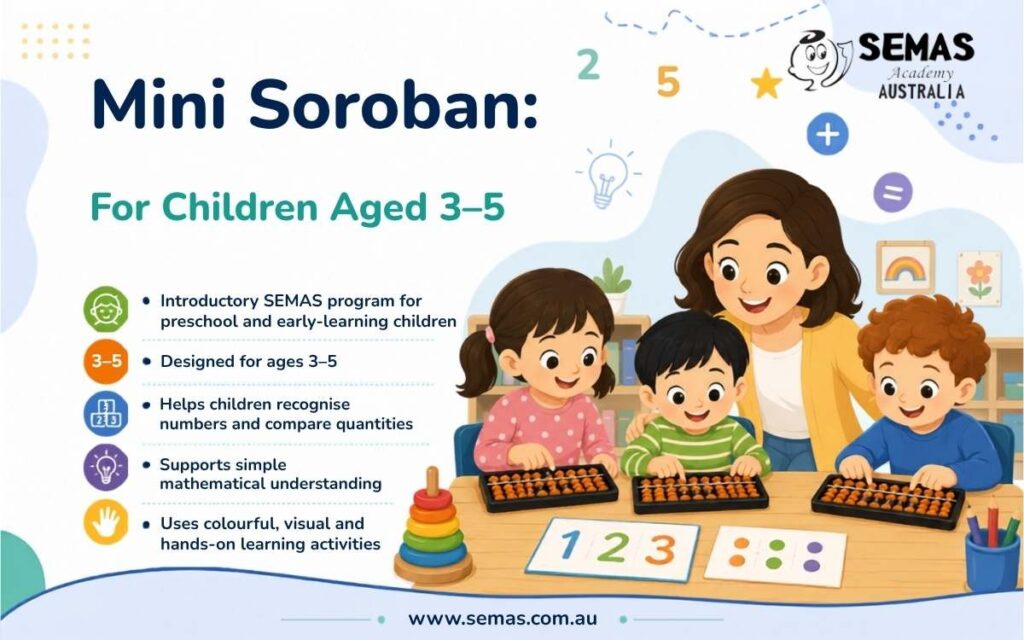
Ages 3–5
Very young learners generally benefit from short activities that maintain their attention.
Practice can focus on:
- Recognising numbers
- Counting
- Understanding bead positions
- Moving beads correctly
- Identifying simple number combinations
- Developing familiarity with the abacus
At this stage, making practice enjoyable is usually more important than introducing speed.
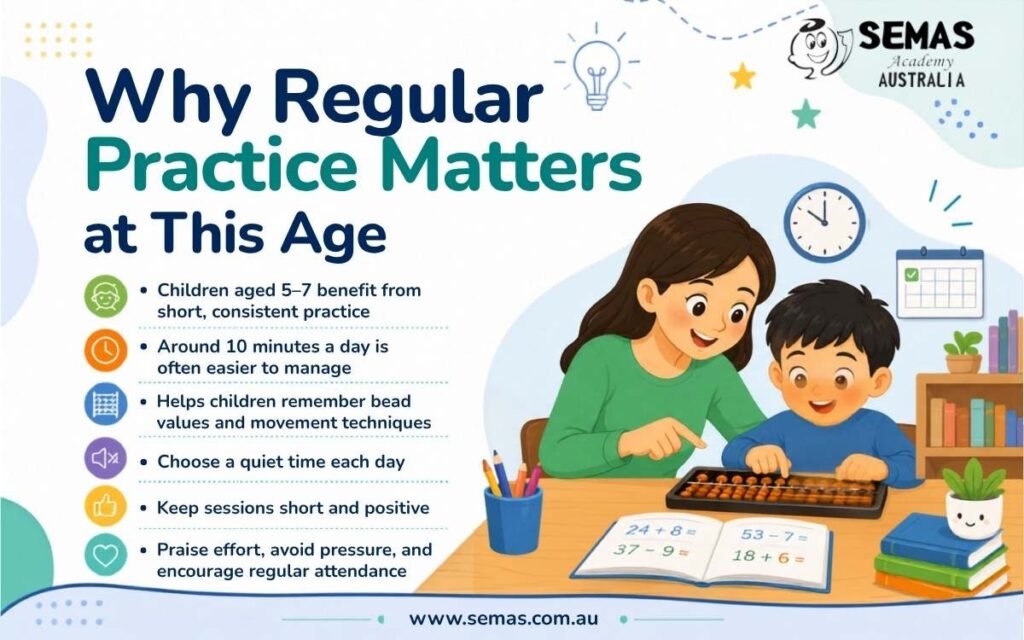
Ages 5–8
Children at this stage may be ready for slightly longer sessions involving:
- Number representation
- Place value
- Addition
- Subtraction
- Calculation worksheets
- Number dictation
- Repetition of classroom exercises
The child should continue focusing on accuracy and technique before worrying about calculation speed.
Ages 8–11
Older or more experienced students may work on:
- More complex calculations
- Faster bead movement
- Accuracy exercises
- Timed activities where appropriate
- Independent problem-solving
- Mental visualisation exercises
Practice should still match the child’s current program level rather than introducing advanced techniques too early.
A Simple Weekly Abacus Practice Routine
Parents do not need to create complicated lesson plans. A basic weekly routine can provide enough variety while keeping practice manageable.
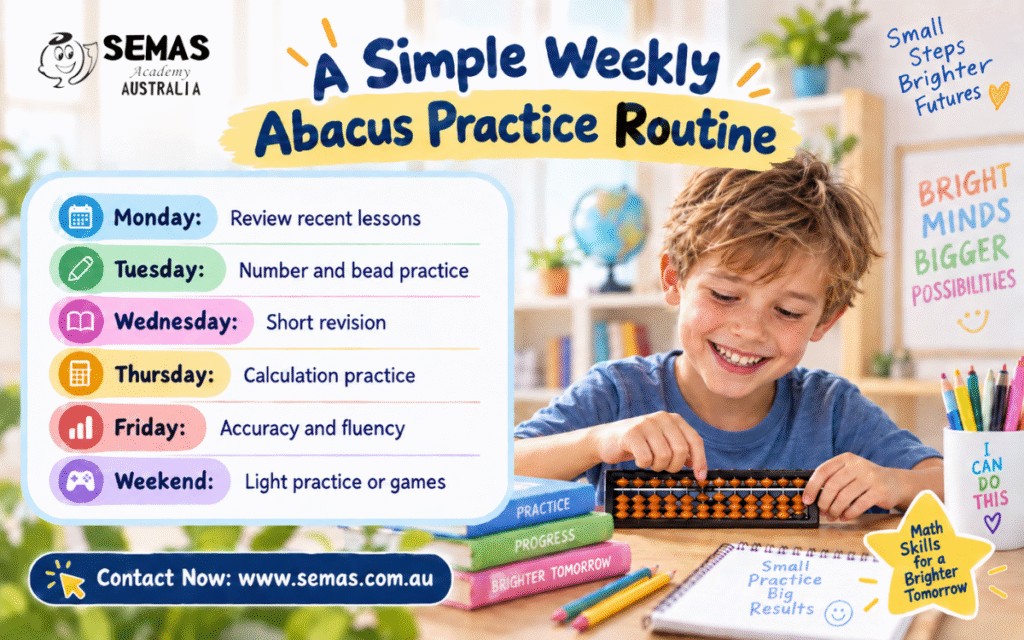
Monday: Review
Spend 15–20 minutes reviewing exercises from the child’s most recent lesson.
The aim is to reinforce new techniques while they are still fresh.
Tuesday: Number and Bead Practice
Practise representing different numbers on the abacus.
For example, ask the child to show:
- 7
- 16
- 42
- 105
- 328
Numbers should be adapted to the child’s ability.
Wednesday: Short Revision
Use a lighter session to revise previous exercises.
This can be particularly useful for younger learners who may not need intensive practice every day.
Thursday: Calculation Practice
Work through addition or subtraction questions that match the child’s current level.
Accuracy should come before speed.
Friday: Accuracy and Fluency
Ask the child to complete several familiar calculations smoothly and independently.
More experienced learners might introduce a timer, but it should be used as a challenge rather than a source of pressure.
Weekend: Light Practice or Games
The weekend can include an enjoyable activity such as number challenges, shopping calculations or asking the child to explain how a calculation works.
What Should Children Practise at Home?
Home practice should generally reinforce what children have already learned during lessons.
Useful activities include:
- Resetting the abacus correctly
- Representing numbers
- Reading numbers displayed on the abacus
- Identifying ones, tens and hundreds
- Addition exercises
- Subtraction exercises
- Number dictation
- Calculation worksheets
- Accuracy exercises
- Speed exercises for experienced students
- Visualisation activities when appropriate
As children become more familiar with abacus maths, exercises can gradually become more challenging.
A useful sequence for home practice is:
Set → Read → Calculate → Check → Repeat
Children should first set up the abacus, understand the number or question, complete the calculation, check the answer and then move to the next exercise.
How to Use an Abacus During Home Practice
Parents often wonder how to use abacus correctly when supporting children at home.
For beginners, keep the process straightforward.
- Place the abacus on a stable surface.
- Reset the beads before beginning.
- Identify the relevant place-value columns.
- Ask the child to represent a number.
- Move to simple calculations appropriate to their level.
- Encourage the child to use the technique taught in class.
- Check the answer before beginning another problem.
Parents who want a more detailed explanation of the basic techniques can also read SEMAS’s guide to practising abacus education.
Should Parents Help With Abacus Practice?
Parents can play an important supporting role without becoming the child’s instructor.
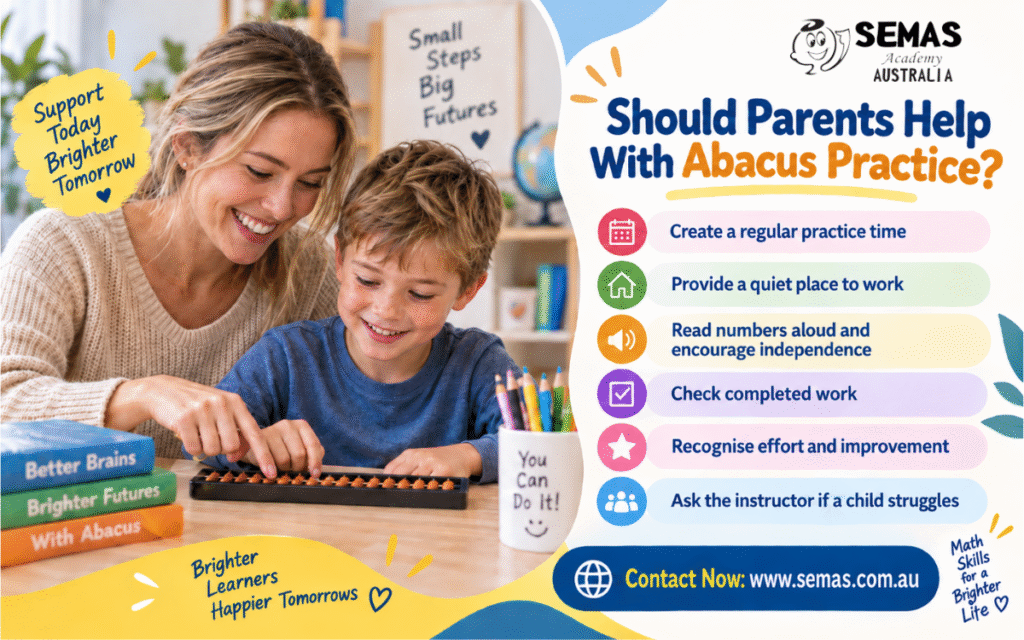
Helpful ways to support home practice include:
- Creating a regular practice time
- Providing a quiet place to work
- Preparing assigned worksheets
- Reading numbers aloud
- Encouraging the child to complete exercises independently
- Checking completed work
- Keeping practice sessions consistent
- Recognising effort and improvement
Parents should be careful about introducing different methods if they are unfamiliar with the technique being taught.
If a child repeatedly struggles with a particular exercise, it may be better to make a note of it and ask the instructor for guidance.
How Can Parents Make Abacus Practice More Interesting?
Repetition is part of learning, but practice does not always need to feel repetitive.
Parents can introduce variety through simple activities.
Use Number Challenges
Call out different numbers and ask the child to represent them correctly.
Create Small Goals
For example:
“Let’s complete ten accurate calculations.”
This can feel more achievable than asking a child to practise for an unspecified amount of time.
Use Everyday Numbers
Numbers from shopping, calendars, scores or household activities can make maths feel more relevant.
Let Children Explain Their Method
Ask:
“How did you get that answer?”
Explaining the process encourages the child to think about what they are doing rather than simply moving beads mechanically.
Track Consistency
A simple weekly practice chart can help children see how regularly they have practised.
The reward should be consistency and effort rather than only speed.
Common Abacus Practice Mistakes at Home
A good routine is also about knowing what to avoid.
Practising for Too Long
Long sessions can become counterproductive when children lose concentration. Shorter sessions are often easier to maintain consistently.
Focusing Only on Speed
Fast calculation may eventually develop, but beginners should first understand correct bead movement and calculation methods.
Skipping Basic Skills
Children should be comfortable with foundational techniques before moving to harder exercises.
Practising Only Once a Week
One very long weekly session may not provide the same regular reinforcement as shorter sessions spread across several days.
Introducing Mental Abacus Too Early
Children normally need familiarity with the physical abacus before relying heavily on mental visualisation.
SEMAS also provides more information about the progression towards mental calculations through abacus learning.
Comparing Children
Every learner progresses differently. Comparing one child’s speed with a sibling, classmate or friend can make practice unnecessarily stressful.
Physical Abacus and Mental Abacus Practice
A common question from parents is when children should stop relying on the physical tool.
There should not necessarily be a sudden switch.
Learning may gradually progress through stages:
Physical Abacus
↓
Understanding Numbers and Place Value
↓
Developing Calculation Fluency
↓
Remembering Bead Patterns
↓
Visualising the Abacus
↓
Mental Calculation
The exact pace varies between learners.
Children should generally develop a strong understanding of the physical abacus before being expected to perform increasingly complex calculations mentally.
Parents unfamiliar with the tool can first learn what an abacus is and how it works before helping with home activities.
How Do You Know If Your Child Is Practicing Enough?
Instead of measuring progress only by minutes spent practicing, parents can observe how comfortably the child is working.
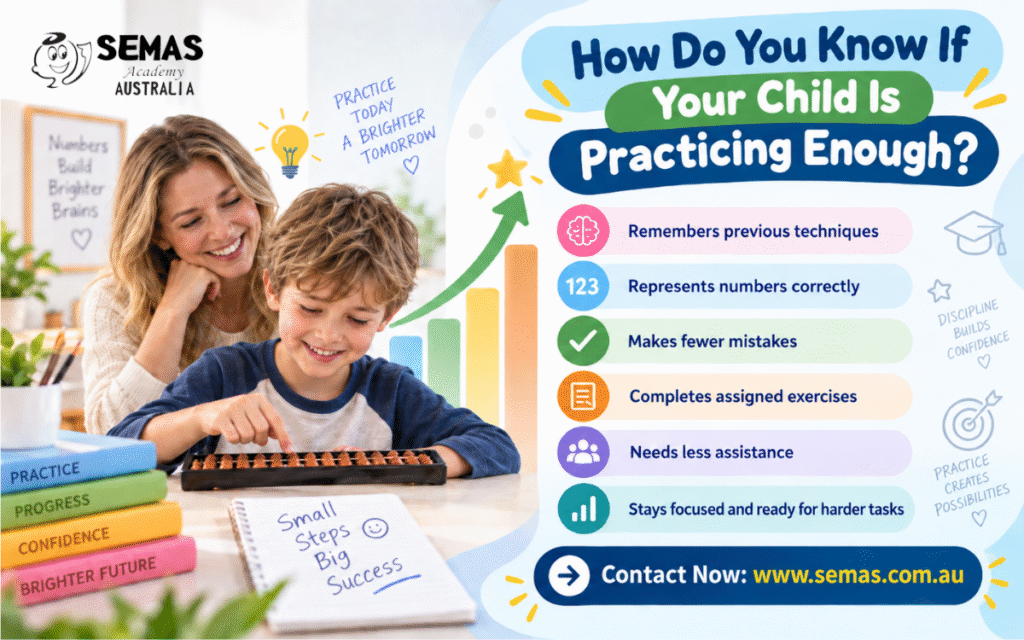
Positive signs can include:
- Remembering techniques from previous lessons
- Representing numbers correctly
- Making fewer calculation mistakes
- Completing assigned exercises
- Requiring less assistance
- Using the abacus more confidently
- Remaining focused during short practice sessions
- Showing readiness for slightly more challenging exercises
If the child consistently struggles, extending the session may not be the solution. Reviewing the difficulty level or discussing the exercises with the instructor may be more useful.
Abacus Classes and Home Practice Should Work Together
Home practice works best when it reinforces structured learning rather than replacing it.
Formal instruction can introduce new concepts, demonstrate appropriate techniques and provide exercises suited to the child’s current ability. Home sessions then give children opportunities to practice those skills between lessons.
Together, structured lessons and regular home practice can create a clearer learning progression.
Parents should therefore try to keep home exercises aligned with the child’s current course rather than jumping ahead simply because the child can complete easier calculations quickly.
Why Choose SEMAS for Abacus Learning?
SEMAS provides structured Soroban and abacus learning programs designed to help children develop their number skills progressively. Children can learn through age-appropriate activities and gradually work from physical bead calculations towards more advanced mathematical exercises.
SEMAS provides different abacus course options and resources for children at various learning stages. Parents looking for a structured approach can explore the SEMAS Abacus Program and choose an option suited to their child’s age and experience.
When professional instruction is supported by sensible home practice, children have regular opportunities to reinforce what they learn without turning every evening into a long math’s lesson.
Final Thoughts
So, how often should children practice abacus at home?
There is no fixed number that works for every learner. For many children, short practice sessions several times per week are a practical starting point. Younger beginners may only need 10–15 minutes at a time, while experienced learners may be comfortable with longer and more frequent sessions.
What matters most is creating a routine that is consistent, age-appropriate and connected to what the child is currently learning.
Focus first on correct technique and accuracy. Let speed and more advanced mental calculation develop progressively rather than forcing them too early.
For parents who want structured guidance, courses and age-appropriate learning pathways, SEMAS provides abacus learning programs for children across different stages of development.
Frequently Asked Questions
How many days a week should a child practice abacus?
There is no strict requirement. For many beginners, three to five short practice sessions spread across the week can provide a manageable routine. More experienced learners may practice more frequently depending on their course requirements.
How long should children practise abacus each day?
Young beginners may start with around 10–15 minutes, while older or more experienced children may be comfortable practicing for 20–30 minutes. Concentration and quality of practice are more important than simply extending the session.
Does my child need to practice abacus every day?
No. Daily practice may suit some children, but consistent practice several times per week can also provide regular reinforcement. The schedule should suit the child’s age, learning level and other commitments.
What should an abacus beginner practice first?
Beginners should generally focus on understanding the abacus, resetting the beads, representing numbers, recognising place value and completing simple calculations using the techniques they have been taught.
Can parents teach abacus at home?
Parents can help children revise and maintain a practice routine. However, if parents are unfamiliar with the method, they should avoid introducing techniques that conflict with the child’s structured lessons.
When should children start practicing mental abacus?
Mental visualisation generally comes after a child has developed familiarity with physical bead movements and number representations. The appropriate timing will depend on the individual learner and their training level.
How can I make abacus practice enjoyable for my child?
Keep sessions short, introduce number games, create achievable challenges, use everyday math’s examples and recognise consistent effort instead of concentrating only on calculation speed.
Is 30 minutes of abacus practice enough?
For many school-age learners, 20–30 minutes can provide plenty of focused practice. Younger beginners may require much shorter sessions. The appropriate duration should reflect the child’s concentration level and current learning program.