
Why Schools Are Adding Abacus Learning to Their Curriculum
Schools are continually looking for practical ways to strengthen students’ mathematical understanding while also developing concentration, confidence and problem-solving skills. Alongside traditional classroom teaching, educational programs that make mathematics more visual and interactive are receiving increasing attention. One approach being introduced by some schools is abacus education, which gives children a hands-on method for working with numbers and developing mental calculation skills.
For parents or educators unfamiliar with the concept, a common question is what an abacus actually does and why it can have a place in modern education. Although the abacus is a traditional calculating tool, structured abacus programs use it as part of a progressive learning process. Children first work physically with beads and calculations before gradually developing the ability to visualise mathematical processes mentally.
Why Are Schools Looking Beyond Traditional Maths Lessons?
Traditional mathematics lessons remain essential, but children do not all understand numbers in the same way. Some students learn effectively through written exercises, while others respond better when mathematical concepts become visual, physical and interactive.
Schools therefore increasingly consider complementary learning activities that can support classroom instruction without replacing the existing curriculum.
A structured abacus program can give children another way to interact with numbers. Rather than simply memorising answers, students practise moving beads, recognising number patterns and working through calculations using a repeatable method.
This can make maths feel more active for young learners.
What Is Abacus and How Does the Learning Process Work?
An abacus consists of beads arranged on rods or columns. Each bead represents a numerical value, allowing learners to physically represent numbers and perform calculations.
When children begin training, they normally use the physical abacus to understand how numbers are formed and manipulated. With continued practice, learners may gradually become capable of imagining the abacus and performing calculations mentally.
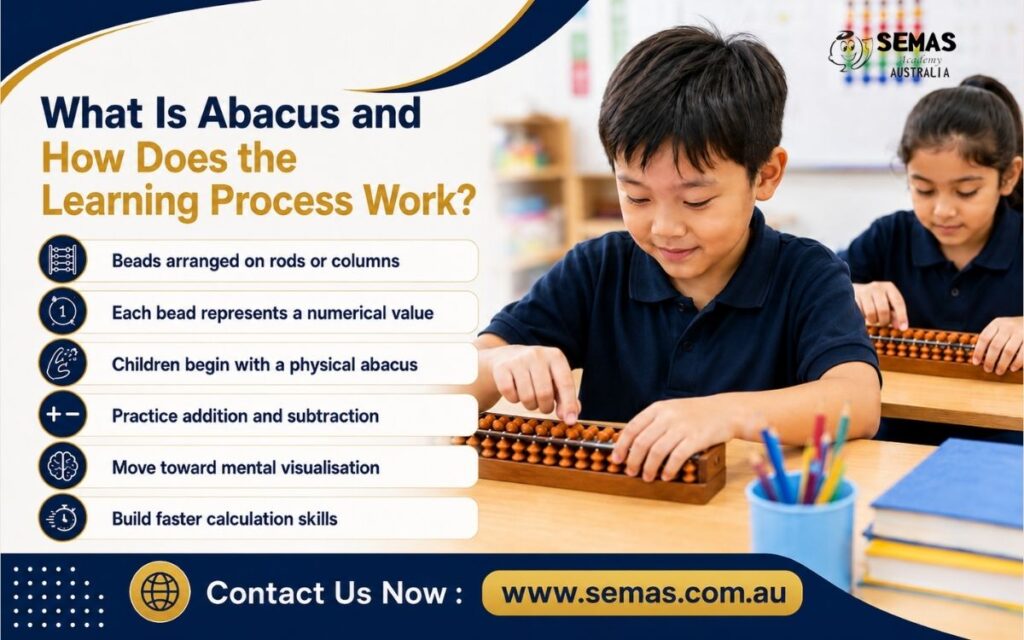
The learning process generally moves through stages such as:
- Understanding the parts and values of the abacus
- Representing numbers using beads
- Practicing addition and subtraction
- Developing faster calculation techniques
- Moving towards mental visualisation
- Solving calculations with less reliance on the physical tool
- Applying stronger concentration during increasingly complex exercises
The objective is not simply to make children calculate quickly. A well-structured program aims to create a systematic way of approaching numbers while encouraging regular practice.
Why Abacus Learning Can Fit into a School Environment
One reason schools may consider abacus programs is their flexibility. They can be delivered as part of the school timetable, as an additional mathematics activity or through an after-school program.
This means schools do not necessarily need to redesign their entire mathematics curriculum.
An abacus program can instead complement existing lessons and provide students with additional opportunities to practice numerical skills.
It can be introduced through:
- Regular classroom sessions
- Weekly enrichment programs
- After-school activities
- Mathematics clubs
- Digital learning sessions
- Small-group learning programs
This flexibility can help schools choose an approach based on available teaching time, student age groups and existing curriculum priorities.
Supporting Mental Maths Skills
Mental maths is useful throughout a child’s education. Students regularly need to estimate, compare numbers, recognise patterns and perform basic calculations without always relying on a calculator.
Abacus exercises provide repeated opportunities to work with numbers.
As children become familiar with the movement and value of beads, they can begin developing a clearer mental representation of calculations.
For example, instead of treating a calculation as an abstract collection of symbols, a learner may associate the numbers with a visual arrangement. This can provide another pathway for understanding mathematical relationships.
A major reason schools are exploring what is abacus and how it can support classroom teaching is this combination of physical practice, visualisation and mental arithmetic.
Developing Concentration Through Structured Practice
Many classroom tasks require sustained attention. Reading instructions, solving a mathematics problem or completing a multi-stage activity all become easier when students can remain focused on the task.
Abacus exercises naturally require attention because learners need to follow sequences accurately while moving or visualising beads.
A student who loses track of a step may arrive at the wrong answer, encouraging them to slow down, focus and follow the process carefully.
Regular structured practice can therefore provide children with another activity in which concentration plays an important role.
Building Confidence with Numbers
Some children begin to view mathematics as difficult after repeatedly struggling with calculations. Once that belief develops, they may hesitate to participate in lessons even when they understand the underlying concept.
Alternative learning methods can sometimes help by presenting numbers differently.
Because abacus exercises often progress from simple activities to more challenging calculations, children can experience small achievements along the way.
Completing an exercise correctly or improving calculation speed can give students a sense of progress.
That progress matters because mathematical confidence is often built gradually rather than through one major achievement.
Abacus as an After-School Learning Activity
Not every school will want to place an additional program directly inside regular classroom hours. An after-school model offers another practical option.
Students who participate can receive structured training while the school’s core timetable remains unchanged.
After-school sessions may also allow instructors to spend more time on repetition, practice and individual progress than might be available during a standard mathematics lesson.
For parents, having an educational activity available through a school environment may also make participation more convenient.
Online Abacus Programs Create Greater Flexibility
Digital education has also changed how supplementary programs can be delivered.
Abacus instruction does not always have to take place in a traditional classroom. Online learning can allow schools or individual students to access structured activities through digital platforms.
This can be particularly helpful when:
- Schools want additional delivery options
- Students cannot regularly attend face-to-face sessions
- Families require more flexible learning arrangements
- Institutions want to combine classroom and online activities
A blended approach can allow physical abacus practice and guided digital instruction to work together.
Can Abacus Learning Replace the School Maths Curriculum?
No. Abacus training should be viewed as a complementary learning method rather than a replacement for a school’s mathematics curriculum.
Students still need to understand mathematical concepts taught at school, including measurement, geometry, fractions, statistics and other areas that extend beyond mental arithmetic.
The value of an abacus program lies in supporting areas such as number familiarity, calculation practice, visualisation and mental arithmetic.
When implemented appropriately, it can sit alongside existing mathematics teaching rather than competing with it.
What Should Schools Consider Before Introducing a Program?
Schools should evaluate an abacus program in the same way they would assess any educational activity.

Important considerations include:
Age suitability
Learning activities should match the developmental level of participating students.
Program structure
Schools should understand how students’ progress from beginner exercises to more advanced levels.
Instructor quality
Teachers or instructors should be able to explain techniques clearly and work effectively with children.
Curriculum compatibility
The program should complement rather than interfere with existing educational priorities.
Learning format
Schools should decide whether classroom, after-school, online or blended delivery is most practical.
Student engagement
Activities should remain interesting and achievable enough to encourage students to continue practicing.
These factors can help schools choose a program based on educational value rather than simply introducing an activity because it is popular.
Why Abacus Programs Appeal to Parents Too
Parents often look for educational activities that provide something different from additional worksheets or tutoring.
Abacus programs offer a distinctive learning experience because children physically interact with a calculating tool before progressing towards visual and mental methods.
For younger learners especially, this can make number practice feel more interactive.
Parents may also appreciate programs that create structured opportunities for children to practise concentration, calculation and problem-solving outside ordinary homework.
However, expectations should remain realistic. Progress depends on factors such as the child’s age, participation, regular practice and the quality of instruction.
Why Choose SEMAS for School Abacus Programs?
SEMAS provides abacus programs designed for children across different learning stages and also works with schools and educational institutions. Its school-focused offering can be adapted to an institution’s requirements and delivered through school curriculum activities, after-school programs or online learning. SEMAS also offers age-based Soroban courses and focuses on helping children visualise mathematics through structured training. For schools exploring a flexible approach to introducing abacus instruction, SEMAS provides options that can be aligned with existing learning goals.
Bringing Abacus Learning Into Modern Education
The growing interest in abacus learning shows that a traditional tool can still have a place within modern education when it is used through a structured teaching approach. Schools can introduce it as an enrichment activity, after-school program or supplementary mathematics resource without replacing their established curriculum.
Final Thoughts
Schools are adding abacus programs because they provide children with another way to explore numbers. By combining physical bead movement, visualisation, repetition and mental calculation, abacus training can complement traditional maths education while encouraging students to approach calculations in a structured way.
For schools, the greatest advantage may be flexibility. Programs can be adapted to different ages, learning environments and timetables. For students, the experience offers an interactive alternative to conventional numerical exercises.
As education continues to combine traditional teaching with different learning methods, the abacus demonstrates that effective educational ideas do not always need to be new. Sometimes, an established learning tool can be adapted to provide today’s students with a fresh way to understand mathematics.