
What Is the Best Age to Start Abacus Classes for Kids?
Every child learns differently. Some children enjoy counting objects before they start school, while others take longer to feel comfortable with numbers. As a parent, you may wonder whether your child is ready for structured maths learning or whether it would be better to wait another year.
The good news is that there is no single perfect starting age. Children as young as three can explore introductory number activities, while many begin more structured abacus classes between four and seven years of age. What matters most is their curiosity, understanding of basic numbers and ability to participate in age-appropriate activities.
So, when should your child begin? Let’s explore the different starting ages, signs of readiness and factors parents should consider before enrolling.
What Is the Best Age to Start Abacus Classes for Kids?
For many children, ages four to seven can be a suitable time to begin learning with an abacus. During these years, children are developing number recognition, counting skills and an understanding of simple mathematical relationships.
However, some children may enjoy introductory abacus activities at three, while others may benefit from starting at eight or older.
An abacus uses movable beads to represent numbers. Instead of working only with written calculations, children can physically move beads to understand quantities and arithmetic operations.
This hands-on approach can make abstract number concepts easier to explore.
The right starting age depends on three important factors:
- Number awareness: Can your child recognise numbers and count familiar objects?
- Learning readiness: Can they follow simple instructions and participate in short activities?
- Personal interest: Do they enjoy number games, puzzles or hands-on learning?
Age provides a useful guideline, but these everyday abilities offer a clearer picture of whether your child is ready.
Can a 3-Year-Old Start Learning Abacus?
Yes. Some three-year-olds can begin introductory abacus activities, particularly when lessons are designed around play, movement and visual learning.
At this age, the focus should not be on completing complicated calculations or memorising mathematical rules.
Instead, children can explore simple activities such as counting beads, identifying numbers, recognising groups of objects and matching quantities.
For example, an instructor might ask a child to move three beads and then find three blocks on a table. This connects a physical action with the idea of quantity.
Sessions should be short, engaging and flexible. If a child loses interest, it may be better to change the activity rather than insist on finishing an exercise.
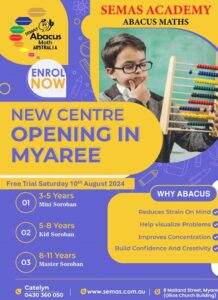
At SEMAS, the Mini Soroban program is designed for children approximately three to five years old, providing an introductory pathway into number-based learning.
Parent Tip: Before considering formal lessons, observe whether your child enjoys counting toys, sorting objects or recognising numbers during everyday activities.
How Does Abacus Learning Differ by Age?
A child’s age can influence how lessons are introduced, how long activities last and which mathematical concepts are suitable.
The following table provides a general guide.
| Age group | Learning focus | Suitable activities |
| 3–4 years | Early number familiarity | Counting beads, matching quantities and recognising numbers |
| 5–6 years | Basic numerical understanding | Simple addition, subtraction and bead movement |
| 7–8 years | Developing calculation skills | Structured arithmetic exercises and number patterns |
| 9–10 years | Strengthening mathematical fluency | Multi-step calculations and mental arithmetic practice |
| 11+ years | Learning at an appropriate individual level | Foundational or more advanced exercises based on experience |
These are illustrative learning stages rather than fixed milestones. A nine-year-old beginner may need introductory lessons, while a younger child with prior experience may be ready for more challenging activities.
Parents should therefore look for a program that assesses children’s abilities rather than placing every student into the same level based on age alone.
5 Signs Your Child Is Ready for Abacus Classes
You do not need to conduct a formal assessment at home. Simple observations during everyday activities can help you understand whether your child may enjoy learning with an abacus.
1. Your Child Shows Interest in Numbers
Does your child enjoy counting stairs, identifying house numbers or comparing the number of toys in different groups?
Such curiosity suggests that numbers are becoming meaningful rather than simply something to memorise.
2. They Can Follow Simple Instructions
Abacus learning involves listening, observing and performing a sequence of actions.
A child who can follow directions such as “move two beads” or “count the objects again” may be comfortable trying introductory lessons.
3. They Enjoy Hands-On Activities
Children who like building blocks, sorting shapes or completing simple puzzles may enjoy the physical nature of an abacus.
Moving beads gives them something tangible to work with while exploring mathematical concepts.
4. They Can Participate in Short Learning Sessions
Young children do not need to sit quietly for an hour.
Being able to participate in a short, engaging activity with occasional guidance is a more realistic sign of readiness.
5. They Are Willing to Try Again
Making mistakes is a normal part of learning mathematics.
A child who can attempt a task again with encouragement may be ready to develop new numerical skills in a supportive environment.
Remember: Your child does not need to demonstrate every sign before beginning. A good instructor can help determine whether the learning environment and activities are suitable.
Is Age More Important Than Learning Readiness?
Imagine two children who are both five years old.
One enjoys counting objects, recognises numbers confidently and asks questions about simple sums. The other prefers creative play and is only beginning to understand quantities.
Both children are developing normally, but they may need different approaches to learning.
This is why age alone should not determine enrolment.
Effective abacus education considers a child’s existing skills, interests and learning pace.
A beginner who needs more time to understand bead values should have that opportunity without feeling behind classmates.
Similarly, a child who already understands basic number relationships may benefit from additional challenges.
Parents should speak with the instructor about their child’s abilities before selecting a learning level.
What Are the Benefits of Starting Abacus Learning Early?
Introducing children to suitable math activities during their early years can help establish positive learning habits.
Abacus learning offers a structured way to practise several foundational skills.
Understanding Numbers Visually
Bead movements allow children to see how quantities change when numbers are added or subtracted.
This can complement the number of activities children experience at school.
Developing Arithmetic Familiarity
With appropriate instruction and practice, children can become more familiar with numerical relationships, place value and calculation processes.
The goal should initially be understanding, rather than completing sums as quickly as possible.
Building Confidence Through Small Achievements
Completing a simple calculation independently can provide a sense of accomplishment.
Recognising small improvements helps children approach progressively challenging exercises with greater confidence.
Encouraging Consistent Learning Habits
Short practice activities can introduce children to the value of patience, attention and repeated effort.
However, starting younger does not automatically produce better long-term mathematical performance. Teaching quality, individual readiness and continued engagement also matter.
Is It Too Late to Start Abacus Maths at Age 10 or Older?
Not at all.
Although many programs introduce younger children to the abacus, older beginners can also learn how to represent numbers using beads and perform calculations.
In fact, an older child may already understand addition, subtraction and place value, making some introductory explanations easier to follow.
The important consideration is choosing an appropriate starting level.
For example, a ten-year-old who has never used an abacus should not automatically begin with advanced exercises simply because of their age.
An instructor can assess existing mathematical knowledge and introduce suitable techniques.
Parents should also consider the child’s interest and available time. A supportive learning experience is more valuable than rushing through levels to catch up with children who started earlier.
How Can Parents Choose the Right Abacus Course?
Once you feel your child is ready, the next step is choosing a suitable learning program.
Not every course follows the same teaching structure, so it is helpful to ask a few questions before enrolling.
Consider the following:
- Age suitability: Does the program offer activities appropriate for your child’s developmental stage?
- Starting assessment: Will an instructor evaluate your child’s existing number skills?
- Teaching methods: Are visual demonstrations and hands-on activities included?
- Class environment: Will your child receive enough guidance and opportunities to ask questions?
- Progression: How does the program introduce more challenging calculations?
- Home practice: What level of practice is expected between lessons?
- Communication: Will parents receive information about their child’s progress?
You can also ask whether an introductory lesson or course discussion is available.
A useful program should help your child develop skills progressively without making mathematics feel unnecessarily stressful.
How Does SEMAS Support Children at Different Learning Stages?
At SEMAS Academy Australia, abacus learning is organised into different Soroban programs to accommodate children’s ages and existing mathematical abilities.
Rather than offering one identical learning pathway for everyone, SEMAS provides courses with different levels of complexity.
The available programs include:
Mini Soroban: An introductory program for children approximately three to five years old, focusing on early numerical understanding and visual learning.
Kids Soroban: A program generally suited to children around five to seven years old, introducing more structured mathematical activities as their confidence develops.
Master Soroban: A more advanced learning pathway, generally intended for children around seven to eleven years old who have a suitable foundation in abacus and mathematics.
These age ranges are guidelines. Parents should confirm the appropriate course with SEMAS based on their child’s experience and readiness.
SEMAS also incorporates interactive activities and guided exercises to make mathematical learning more approachable.
The aim is to help children establish a foundation they can build upon as they progress.
Frequently Asked Questions About Starting Abacus Classes
1. Can a 3-year-old start abacus classes?
Yes. Some three-year-olds can participate in introductory abacus activities involving counting, bead movement and number recognition. The lessons should be designed for young learners, with an emphasis on enjoyment rather than calculation speed.
2. Is four years old too early for abacus learning?
Not necessarily. Four-year-olds who recognise basic numbers, enjoy counting activities and can follow simple instructions may be ready for beginner lessons. Their individual readiness is more important than age alone.
3. Does my child need to know addition before joining?
Not always. Introductory programs may teach basic number relationships before moving to addition and subtraction. Parents should check the entry requirements of the chosen course.
4. How long does it take children to learn abacus maths?
The learning timeline varies according to the child’s age, previous mathematical knowledge, teaching approach and practice consistency. Basic bead movements may be introduced early, while confident mental calculation can require much longer.
5. Should children practise abacus every day?
Regular short sessions can be helpful, but practice should remain manageable and age-appropriate. The best routine is one that supports steady learning without creating unnecessary pressure.
6. Can abacus learning help children who struggle with maths?
Some children may find visual, hands-on number activities helpful when exploring mathematical ideas. However, an abacus is not a guaranteed solution for every learning difficulty. Parents should consider individual needs and seek appropriate educational support when necessary.
Help Your Child Take the First Step Towards Abacus Maths
Choosing the right age is only the beginning. The learning experience itself can influence whether your child develops an interest in exploring numbers.
If your child enjoys counting, recognises basic quantities or shows curiosity about mathematical activities, it may be worth exploring an introductory program.
At SEMAS, children can discover abacus maths through structured, age-appropriate learning activities that introduce numbers in a visual and practical way.
Parents can explore the available Soroban programs and speak with the SEMAS team to understand which learning stage may suit their child.
Conclusion
There is no universal best age to start learning abacus. Some children are ready for simple activities at three or four, while others may begin more confidently during primary school.
The most useful approach is to consider your child’s interest, number awareness and willingness to learn.
Whether your child is an enthusiastic young counter or an older beginner, starting at a comfortable level can make learning more enjoyable.
Explore SEMAS Academy Australia’s learning programs to find a suitable starting point and help your child develop a positive relationship with mathematics.